

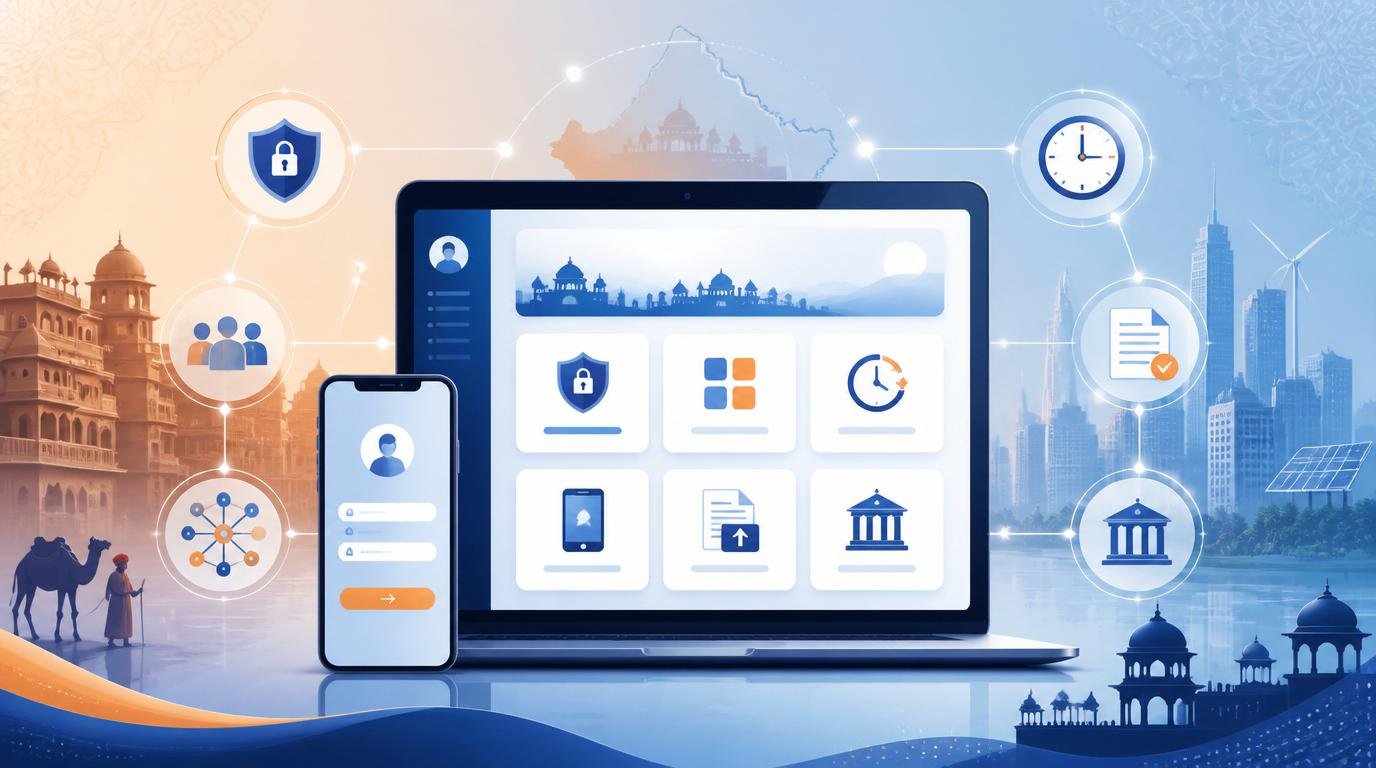
Think about how many times you have created a new username and password just to access a single government service. Now multiply that across dozens of departments — jobs, pensions, health schemes, utility bills, land records — and the frustration becomes very real. Rajasthan solved this problem more than a decade ago with a system that most people still do not fully understand, even if they use it every day.
The Single Sign-On system, commonly known as the SSO portal, is one of the most ambitious and successful digital governance initiatives in India. At its core, it gives every citizen, government employee, and business owner in Rajasthan one unified digital identity to access hundreds of state services. That identity is their SSOID — a unique credential that acts as a master key to the entire digital infrastructure of the state government.
The Origin and Growth of Rajasthan's Digital Identity
The Rajasthan SSO system was launched in 2013 by the Department of Information Technology and Communication, commonly referred to as DoIT&C, under the Government of Rajasthan. The development and technical implementation was handled by the Rajasthan State Electronics Development Corporation. The timing was deliberate — this was the period when India was beginning to seriously invest in digital public infrastructure, and Rajasthan positioned itself as a frontrunner.
What started as a platform to simplify access to a handful of services has grown into something far more impressive. By 2024, the system had provisioned over 2.96 crore digital identities, recorded more than 180 crore hits, and made accessible over 300 government-to-government applications along with nearly 200 citizen and business-facing services. These are not just numbers on a government report. They reflect millions of people who no longer have to stand in queues or manage a tangle of separate logins for every department they interact with.
The system also received national recognition. It won the SKOCH eGov Award twice and has been acknowledged by the Ministry of Electronics and Information Technology at the central government level, as well as by organizations such as C-DAC and NIC. Other states have studied the model as a reference for their own e-governance efforts.
How the SSO System Actually Works
The principle behind Single Sign-On is simple but powerful. A user logs in once through a central authentication server, and that single verified session grants access to every connected application. There is no need to log in separately for the e-Mitra portal, then again for the recruitment platform, then again for the scholarship system. One login covers all of them.
Under the hood, the system relies on a central identity repository. When you log in using your credentials, the server validates your identity and issues a session token. Every connected government application recognizes that token and allows you access without asking for fresh credentials. When you log out, the session closes across all connected services at once.
The digital identity under this system is more than just a username and password. It includes a government email account, an eVault which functions as a digital locker for storing official documents, and an eSign facility that allows users to digitally sign documents — all tied to the same identity. This makes the system not just convenient but genuinely functional for paperless governance.
Who Can Register and What You Need
The SSO portal serves three distinct types of users, each with a slightly different registration path. Citizens of Rajasthan register using their Jan Aadhaar card, which is the state's family identity document, or through Aadhaar. Those without these documents can also register using a Google account, which is particularly useful for people who have relocated from other states but work or study in Rajasthan.
Government employees have a separate registration path using their SIPF number — the credential linked to the State Insurance and Provident Fund. This specific route unlocks government-only portals like Raj Kaj, the internal enterprise resource planning system used for managing files, leave applications, and annual performance appraisals.
Businesses operating in Rajasthan register under the Udyog category using their Business Registration Number or Udyog Aadhaar. This gives them access to commercial services such as tender applications, GST-related portals, and business licensing systems.
One important detail worth noting: registration is completely free. If anyone — whether an agent, an eMitra kiosk operator, or a third-party website — charges a fee for creating an SSOID, that is a scam. The Government of Rajasthan does not charge citizens for this service, and the official portal at sso.rajasthan.gov.in is the only legitimate registration point.
The Services You Can Access With One Login
The range of services accessible through the SSO portal covers almost every interaction a citizen might have with the state government. Employment seekers can apply for positions through the Rajasthan Public Service Commission and the Rajasthan Staff Selection Board. Students can check exam results, apply for scholarships, and track admission status. Pensioners can manage their details through RajSSP. Farmers can access subsidy information and apply for agricultural loans.
Beyond personal services, the portal also handles everyday utility needs. Electricity bills, water bills, and property tax payments can all be processed without visiting any physical office. Citizens can apply for caste certificates, domicile certificates, and income certificates through the e-Mitra integration, which operates through over 50,000 kiosks spread across every district of the state.
Healthcare is another significant dimension. The portal connects to digital health records and government schemes like the Chiranjeevi Yojana, which provides health insurance coverage. Land and property-related services are accessible too — users can check records, apply for mutation, and handle revenue department requirements from the same dashboard.
The system also demonstrated its practical value during the COVID-19 pandemic, when the government used the platform to issue e-passes and connect citizens to emergency health services rapidly, without building a separate infrastructure from scratch.
Registering for the First Time
The process is straightforward and takes roughly five minutes. You visit the official portal, click on the Register option, and choose your user category. Citizens select the Citizen or Udyog tab, while government employees use the Government Employee tab. After selecting your verification method — Jan Aadhaar for most citizens, SIPF for government staff — the system sends an OTP to your registered mobile number for authentication. Once verified, you set a username and password, and your account is active immediately.
One thing to keep in mind is that the mobile number you use during registration becomes the primary recovery tool. If you ever forget your password or lose access, the system relies on this number to verify your identity. Keeping it updated in your profile is therefore not optional — it is genuinely important for uninterrupted access.
Security and Why You Can Trust This System
A question many people have is whether a single login for everything is actually safe. The logic seems counterintuitive at first — if someone gets access to one set of credentials, they get access to everything. This is a valid concern, and the SSO system addresses it through multiple layers of protection.
Every login requires a captcha, which blocks automated attacks. OTP-based verification adds a second factor of authentication before sensitive actions can be performed. Passwords are case-sensitive and the system locks accounts after repeated failed attempts to prevent brute force access. The entire platform is managed by a government department with accountability for data protection, and the infrastructure has handled over 180 crore hits, which is evidence of both scale and stability.
The eVault component deserves specific mention. Official documents stored in the digital locker are government-verified, which means they carry the same legal weight as physical copies for the purposes of state services. This removes the need to carry original certificates to government offices for routine verifications.
A Model Worth Examining Beyond Rajasthan
What makes Rajasthan's SSO system genuinely notable is that it was built entirely in-house by a state government department. It was not outsourced to a private technology vendor or built on top of a commercial platform. DoIT&C designed, developed, and continues to maintain it using internal capacity. That is rare in the Indian e-governance landscape and is one reason why the model has attracted interest from other states and central government bodies.
The system has evolved continuously since 2013. The integration with Jan Aadhaar in 2019 strengthened identity verification. The rapid deployment of pandemic-era services between 2020 and 2021 showed operational flexibility. More recent enhancements have focused on mobile accessibility through the Raj SSO app, which brings the full portal experience to Android and iOS devices for users who primarily access the internet through smartphones.
Whether you are a student applying for a scholarship, a farmer checking subsidy status, or a government employee managing leave records, your interaction with the Rajasthan government increasingly begins and ends in the same place. Understanding how that system works — what it offers, how to use it correctly, and how to keep your account secure — is simply practical knowledge for anyone living or working in the state.
